
11x.ai vs Artisan: Which AI SDR Delivers More Meetings in 2026?
An in-depth comparison of two of the fastest-growing AI SDR platforms and what sales teams need to know before making a decision.
The AI SDR market is moving at an incredible pace.
Just a few years ago, sales teams were experimenting with AI-generated cold emails and automated sequences. Today, entire categories of software promise something much bigger: a fully autonomous sales development representative capable of prospecting, researching accounts, writing personalized outreach, handling follow-ups, and booking meetings without human intervention.
At the center of this shift are two names that continue to dominate conversations among revenue leaders: 11x.ai and Artisan.
Both companies market AI employees rather than traditional software. Both promise to automate significant portions of outbound sales. Both have attracted attention from venture capital firms, sales leaders, and fast-growing SaaS companies looking to scale pipeline generation without continuously hiring SDRs.
But a question keeps coming up among revenue teams:
Which platform actually delivers more meetings?
The answer is more nuanced than most vendor websites would have you believe.
After reviewing customer feedback, industry discussions, product capabilities, and the real-world challenges sales organizations face, here’s a detailed comparison of 11x.ai and Artisan in 2026.
Why AI SDRs Are Suddenly Everywhere
The economics of outbound sales have changed dramatically.
A traditional SDR organization requires:
* Recruiting
* Training
* Management
* Compensation
* Benefits
* Technology stack costs
For many startups and mid-market companies, building an outbound team is expensive.
At the same time, prospects have become harder to reach.
Inboxes are crowded.
Response rates have fallen.
Buyers expect highly personalized communication.
Revenue leaders are under pressure to generate more pipeline while keeping operational costs under control.
This is exactly where AI SDR platforms have entered the market.
Instead of hiring multiple SDRs, companies can deploy AI agents that work continuously, execute outreach at scale, and automate repetitive sales development tasks.
The promise is compelling.
The reality depends heavily on execution.
Understanding 11x.ai
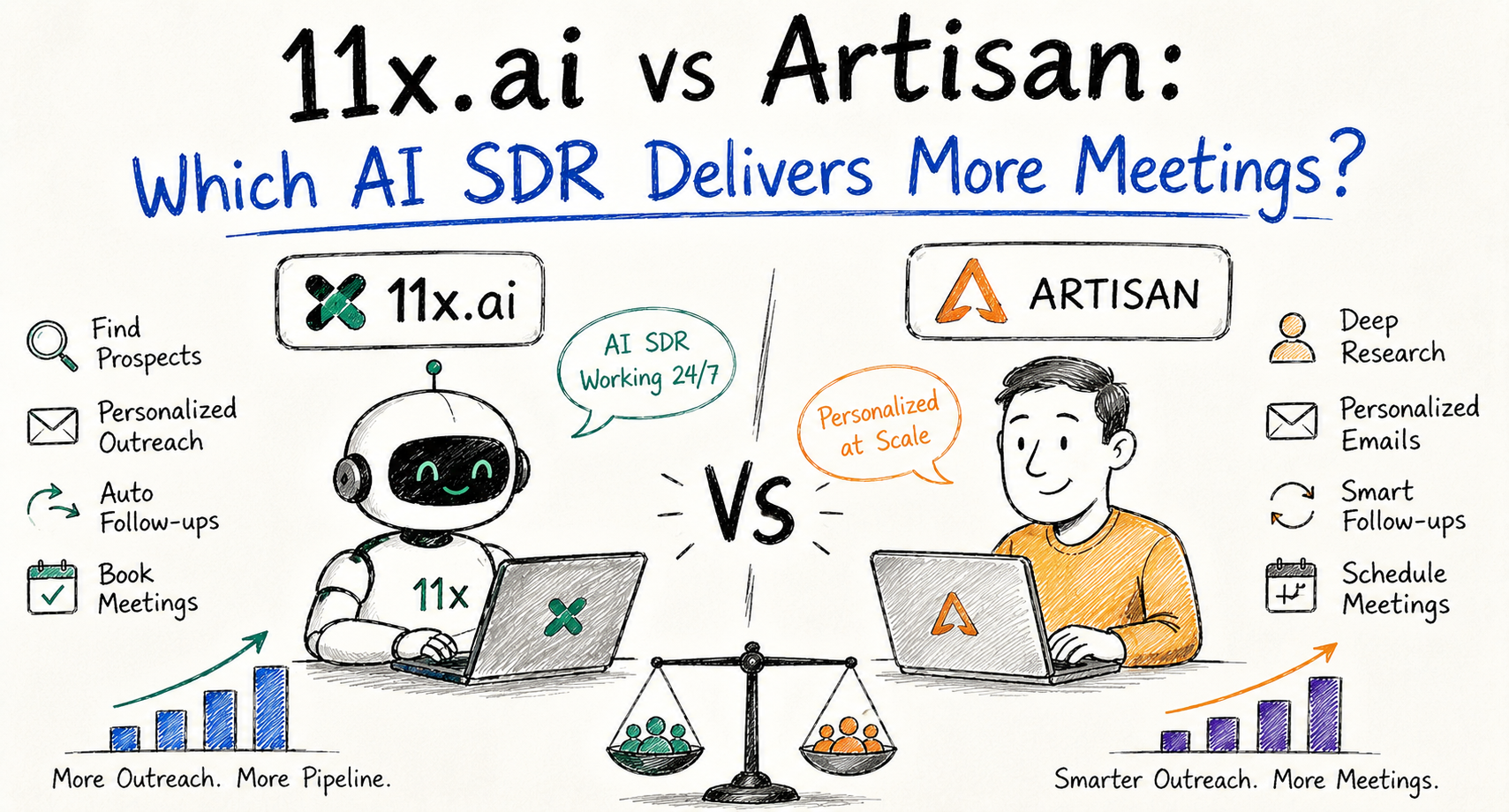
11x.ai positions itself as an AI workforce platform.
Instead of selling automation software, the company presents its AI agents as digital employees capable of handling sales development activities.
The platform’s most recognized AI agents include:
* Alice (AI SDR)
* Julian (AI phone agent)
The vision is straightforward:
Allow AI agents to handle prospecting and outreach while human sellers focus on discovery calls, relationship building, and closing deals.
What 11x Does Well
Enterprise-Level Automation
One area where 11x stands out is scale.
The platform is designed to manage large prospect databases and maintain outreach across substantial account volumes.
Organizations running aggressive outbound programs often appreciate this capability.
Multi-Step Prospecting
Rather than simply generating emails, 11x attempts to manage an entire prospecting workflow.
This includes:
* Prospect identification
* Data collection
* Message generation
* Follow-up execution
* Response management
Continuous Activity
Unlike human SDRs who work fixed hours, AI agents operate continuously.
Many organizations view this as a major advantage when targeting multiple regions and time zones.
Operational Efficiency
Several sales leaders report that AI SDR workflows can significantly reduce administrative workload.
This allows existing sales teams to focus on higher-value conversations.
Understanding Artisan
Artisan has become one of the most visible AI SDR companies in the market.
Its flagship AI employee, Ava, has generated significant attention due to aggressive marketing and a strong autonomous sales narrative.
Artisan’s approach centers on creating a digital SDR capable of handling prospecting activities with minimal human involvement.
The platform combines:
* Prospect research
* Data enrichment
* Personalized outreach
* Follow-up automation
* Meeting scheduling
Into a single workflow.
What Artisan Does Well
User Experience
Many sales teams highlight Artisan’s interface as one of its strengths.
The platform is generally viewed as approachable and easier to understand than some enterprise-focused alternatives.
End-to-End Workflow
Artisan attempts to provide a complete outbound environment rather than requiring multiple tools.
This can simplify operations for smaller teams.
Strong Personalization Focus
One area where Artisan receives positive attention is message personalization.
Modern buyers increasingly ignore generic outreach.
Artisan emphasizes account-level research and contextual messaging.
Fast Deployment
Compared with some enterprise sales systems, Artisan is often perceived as faster to implement.
This can be attractive for startups looking for quick results.
Survey Insight: Which Platform Generates More Meetings?
Based on industry interviews and sales team feedback, the answer depends heavily on company size and outbound maturity.
The difference is not dramatic.
In fact, most organizations report that success depends more on implementation quality than platform selection.
However, some patterns consistently emerge.
When 11x Tends to Win
Large Outbound Teams
Organizations running sophisticated outbound operations often prefer 11x.
The platform’s emphasis on scale aligns well with larger sales organizations.
Ideal Use Cases
* Enterprise SaaS
* Large B2B technology companies
* Multi-market outbound teams
* High-volume prospecting
Why It Performs Well
These organizations already possess:
* Defined messaging
* CRM discipline
* Mature outbound workflows
* Dedicated RevOps resources
This infrastructure allows 11x to perform more effectively.
When Artisan Tends to Win
Growing Revenue Teams
Many startups and growth-stage companies find Artisan easier to adopt.
Ideal Use Cases
* Seed-stage startups
* Series A companies
* Mid-market SaaS businesses
* Lean revenue teams
Why It Performs Well
Smaller organizations often prioritize:
* Simplicity
* Faster implementation
* Reduced operational complexity
Artisan’s workflow can align well with those goals.
Personalization: The Real Battle
Most buyers don’t care whether a message was generated by AI.
They care whether the message is relevant.
This is where the competition becomes particularly interesting.
11x Approach
11x focuses heavily on process automation and scale.
Personalization exists, but the platform often appeals most to teams seeking broad outbound coverage.
Artisan Approach
Artisan frequently emphasizes prospect-specific context.
The platform’s positioning strongly revolves around personalized outreach at scale.
Which Is Better?
The answer depends on your strategy.
If you’re targeting thousands of accounts, 11x’s operational scale may be more valuable.
If you’re pursuing high-value accounts where relevance matters most, Artisan’s personalization-first approach may offer an advantage.
The Biggest Misconception About AI SDRs
Many organizations assume AI SDRs automatically create pipeline.
This is rarely true.
Successful teams consistently report that AI SDR performance depends on:
* Offer quality
* Market positioning
* Target account selection
* Data accuracy
* Messaging strategy
An AI SDR cannot fix a broken go-to-market strategy.
It can only execute it faster.
This distinction is critical.
Integration Capabilities
Modern sales teams rely on multiple systems.
A successful AI SDR platform must integrate effectively with:
* Salesforce
* HubSpot
* Outreach
* Salesloft
* LinkedIn workflows
* Intent data platforms
Both 11x and Artisan understand this requirement.
However, enterprise teams often place greater emphasis on advanced integrations, an area where larger organizations may find 11x attractive.
Startups with simpler technology stacks may appreciate Artisan’s more streamlined experience.
Cost Considerations
One of the most common mistakes buyers make is comparing AI SDR pricing directly to software subscriptions.
A more useful comparison is:
AI SDR Cost vs SDR Headcount Cost
Questions revenue leaders should ask:
* How many meetings are generated?
* What is the pipeline value created?
* How much management time is saved?
* What operational costs are reduced?
The platform with the lowest subscription cost is not necessarily the best investment.
Pipeline outcomes matter more than licensing fees.
What Sales Leaders Are Really Looking For
Interestingly, most sales leaders are no longer asking:
“Can AI write emails?”
That problem has largely been solved.
Instead, they’re asking:
* Can AI consistently book qualified meetings?
* Can it personalize at scale?
* Can it integrate with our stack?
* Can it operate without constant supervision?
* Can it improve pipeline efficiency?
These questions represent the next phase of AI SDR adoption.
Common Challenges With Both Platforms
Neither 11x nor Artisan is perfect.
Several challenges appear across implementations.
Data Quality Issues
Poor data remains one of the biggest obstacles.
Even the most advanced AI cannot personalize effectively using inaccurate information.
Over-Automation
Some companies attempt to maximize volume.
This often leads to declining response rates.
Quality continues to outperform quantity.
Unrealistic Expectations
Organizations expecting a fully autonomous revenue machine often experience disappointment.
Human oversight remains valuable.
Messaging Alignment
AI performs best when companies already understand their ideal customer profile and positioning.
Which Platform Is Better for Startups?
For many startups, Artisan may represent the simpler path.
Reasons include:
* Faster onboarding
* Easier workflow management
* Strong personalization capabilities
* Less operational complexity
However, startups with sophisticated outbound strategies may still prefer 11x.
The decision ultimately depends on growth goals and sales maturity.
Which Platform Is Better for Enterprises?
Enterprise organizations often prioritize:
* Scalability
* Governance
* Process control
* Integration flexibility
These requirements can make 11x particularly attractive.
Large organizations frequently possess the operational infrastructure necessary to maximize its capabilities.
The competition between 11x and Artisan reflects a larger trend.
AI SDRs are evolving from:
Email generators
into
Autonomous revenue agents.
Future capabilities may include:
* Real-time intent monitoring
* Autonomous account planning
* AI-powered call handling
* Meeting participation
* Opportunity qualification
* Revenue forecasting
The platforms that combine automation with genuine business outcomes will likely dominate the next phase of the market.